
Hologram technology is a three-dimensional projection that is formed through a laser light beam and it can be seen without the use of any specific equipment from any angle. This technology has evolved in recent years and is expected to be used widely all over the globe because of the representation of the objects that make them appear as the objects are floating in space. Many industries are already using this advanced technology to get in-depth visualization of objects. Some of the applications of hologram technology are as follows:
In the IT industry hologram technology can be used to enhance the user experience and communication by creating interactive data visuals. Hologram technology can provide a unique way to visualize data sets that are complex such as visualizing large-scale network architectures, cloud computing architectures, cybersecurity threats, and data flows, etc. The representation of data through using Hologram technology can make the identification of data patterns, data breaches, and anomalies simpler and easier and can make decision- making more effective. Besides data visualization, hologram technology can provide an immersive training environment, the technology can be used to visualize the augmented view of the complex IT infrastructure, etc.

The art and Entertainment industry uses hologram technology to enhance the consumer experience and to add new dimensions of creativity and interactivity. This technology can be used to project the illusion of live performances and create engaging and interactive museum exhibits, and visual effects for the theater. Besides this hologram technology is being integrated into VR and AR platforms for creating characters and a dynamic environment, especially for advertising and marketing purposes, etc.
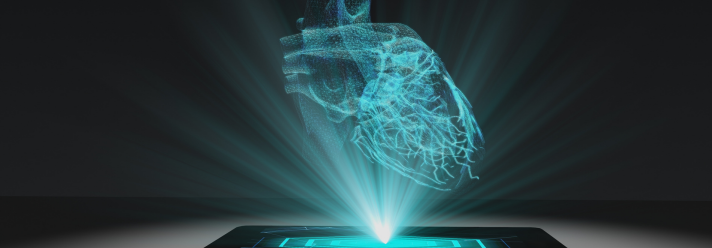
In the healthcare industry hologram technology is used in creating 3D visualizations of medical data, such as CT scans and MRI images. The 3D visuals allow doctors to examine diseases and injuries more accurately. This technology can also assist surgeons in planning surgeries that are complex and can enable remote consultations by providing 3D visuals of patient anatomy and it allows scientists to visualize complex biological structures.
Another effective use of hologram technology is in the educational sector where to deliver lectures and transfer information digitally holographic images are being used to explain complex courses. Creating virtual laboratories is one of the uses of hologram technology that allows students to perform experiments in a virtual environment without using any physical equipment. Providing 3D visuals in subjects like anatomy, biology, history, archaeology, geography, etc. is another use of hologram technology in the educational sector.
In the security industry hologram technology is found to be significant in terms of enhancing security measures. This technology is being used on National ID cards, licenses, passports, legal documents, products, and bank paper instruments to make it difficult for others to replicate it and verify its authenticity.
In the retail sector hologram technology is found to enhance the consumer experiences by allowing them to interact with 3D designs of the products from various angles. Besides the visual representation holograms can be used by the consumers to virtually try on products, and are used by the retailers to showcase featured products and new arrivals in the store and other events as well.
1- Ramachandiran, C.K., Chong, M.M., Subramanian., P., 2019. 3D hologram in futuristic classroom: A review.
2- Haleem, A., et al., 2022. Holography and its applications for industry 4.0: An overview.
3- Moro, C., Phelps, C., Jones, D., Stromberga, Z., 2020. Using Holograms to Enhance Learning in Health Sciences and Medicine.
4- Liu, Y., Wu, S., Xu, Q., Liu, H., 2021. Holographic Projection Technology in the Field of Digital Media Art