

Odoo Implementation Methodology
Odoo is a suite of open-source business apps that cover all the areas of a company which
include CRM, eCommerce, accounting, inventory, point of sale, project management, etc. This
software is implemented by Odoo consultants who use dierent methods and methodologies
for the implementation of Odoo, among these few include scrum methodology, agile software
development methodologies, and waterfall software development methodology. The method
used to implement the app describes the success of the implementation of Odoo or any
other ERP software. Depending upon the functionalities that the client wants to be added
into the ERP application the methodology should be used to make the implementation
successful.
The implementation methodology has 10 phases which flow from the confirmation of vendor
to new requirement analysis. The first step is the requirement analysis which includes the
requirement collection, After this designing, development, customization, and demonstration
of the application take place. After the 2nd and 3rd stages, the testing of the application
starts, and once the testing is completed, the delivery phase starts. The completion of the
delivery then marks the start of the pilot testing leading to solving all the issues that occur.
This leads to the rollout phase in which the installation is done on the client server and the
user can use it once training is completed. After the roll out stage, the sign-o phase comes
in which the delivery of the module as desired by the client is completed and it ends once the
client is fully satisfied with the implementation and functionality of the Odoo. The process of
implementation is then completed and for further customization and development, a new
requirement analysis is conducted.
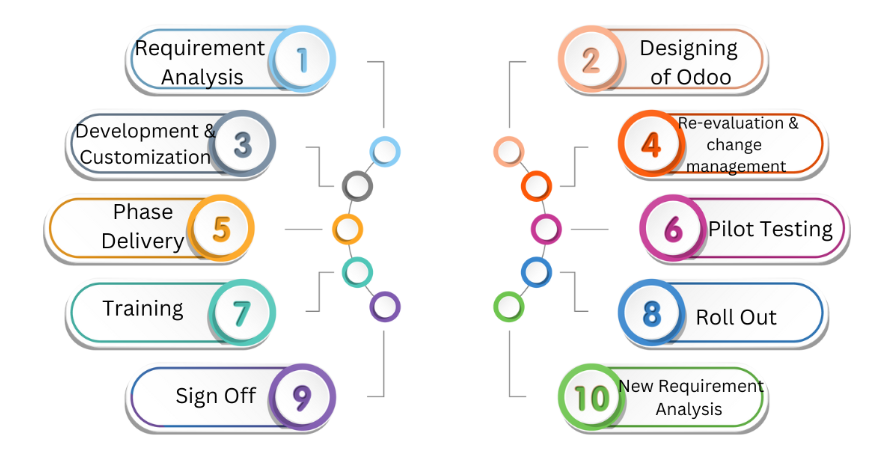
The initial stage of the implementation methodology is requirement analysis in which the requirements are gathered from the client.
Designing of Odoo takes place once the requirements are collected from the client. This phase requires communication and coordination among the employees to ensure proper development of the modules. However, based on the methodology the approach may dier and the level of co-ordination may also vary.
Development and customization of modules is the third phase of the implementation in which based on the client's reviews the changes during the development are made.
In this phase, the changes are being made to the modules as per the requirement of the client which after the satisfaction of the client with the changes is moved to the delivery phase.
Once the changes are made as per the requirement of the client then the delivery of the Odoo app or specific modules starts.
After the delivery phase, the pilot testing of Odoo starts in which the modules implemented in different departments are tested whenever a change occurs in any one module to detect the impact of modules on each other.
In this phase, the Training is given to respective employees in which the functionalities of Odoo modules are made clear to them.
The roll out stage marks the complete installation of Odoo on the client-server which can be used by the user on the live server after completing the training.
In this phase, the implementation is completed with the delivery of the module and with the satisfaction of the client.
New requirement Analysis is the phase in which the requirements for further customization and development are gathered from the client and once it is completed the process starts again with the design of Odoo and ends at sign-o. The methodology used for the implementation of modules may vary as per the needs and requirements of the client.
1- Issuu. Odoo Implementation Methodology: A Comprehensive Guide for Success